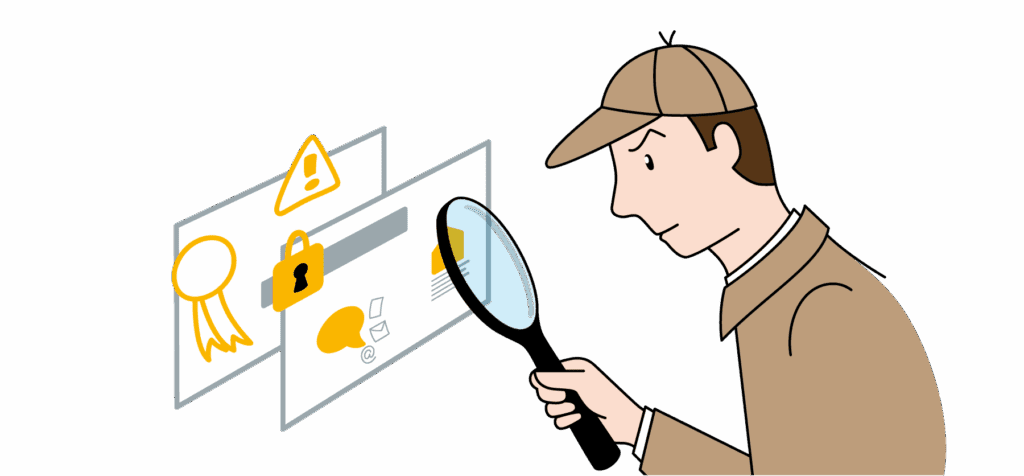
Is an online platform promising high returns and exclusive tips? It is often a complete scam. These 7 steps help you to see through fraudulent websites.
Check for clues on the website
1. Check the site’s security and URL
Serious websites’ addresses start with “https://” and the address bar shows padlock icon in the browser window – which means a secure connection. Be on your guard if either feature is missing or if the URL contains spelling mistakes or extra characters. Domain names that are similar to those of well-known providers may also be fraudulent.
2. Check the legal notice (Impressum) and provider information
A complete legal notice is compulsory and contains the company name, legal form, address of its registered office, the name of the supervisory authority and other details. If such details are missing or incomplete, this is a clear warning signal.
3. Check how you can contact them
Are there reliable means to contact the provider? Anonymous web forms, or options for communicating via WhatsApp, Signal or Telegram as unusual. You should be sceptical if the telephone numbers do not match the apparent registered address, or change constantly.
4. Suss out the product
Do you understand the product being offered? Fraudulent providers often use exaggerated promises, like “maximise profits without the risk”. Exercise particular care for product offerings for CFDs, forex, crypto-assets or loans without credit checks. Advance payments to cover fees and charges are a clear warning signal.
Find information on other websites
5. Does the provider hold a licence?
Banks, brokers, CASPs etc. that target customers in Austria, must be listed in the FMA Company Database. For offerings from outside the EEA, visit the registers of their supervisory authorities – for example the FCA in the United Kingdom or FINMA in Switzerland.
6. Have warnings or testimonies been published?
Has the FMA or another authority issued a warning about the provider? IOSCO also collates warning notices from supervisory authorities around the world. A simple Google search can also provide important clues. Ratings on portals like Trustpilot or ScamAdviser show whether other people may have already had bad experiences.
7. Who registered the domain and when?
You can check when the website was registered using www.who.is. If a platform claims to have existed for many years, but was only registered a few months ago, this claim doesn’t match up. Even if no information is displayed about the operator, this may be a warning signal.
Become an online detective with a couple of well-placed clicks and a critical eye, and see through false promises online instantly!
Other editions:
A to Z of Finance:
A-Z of Finance: www.fma.gv.at > A-Z of Finance
Instagram: Let’s talk about money
Podcast: listen here!
CASP – Crypto Asset Service Provider:
Service provider for crypto-assets e.g. Offering to exchange or trade them or provide custody services.
International financial supervisory authorities:
FCA: Financial Conduct Authority, United Kingdom
FINMA: Switzerland
IOSCO: International Organization of Securities Commissions, international association for securities supervision authorities
Trustpilot:
an online ratings platform, where customers share their experiences about companies.
ScamAdviser:
A website that assesses websites’ credibility based on a combination of technical information and user feedback.